
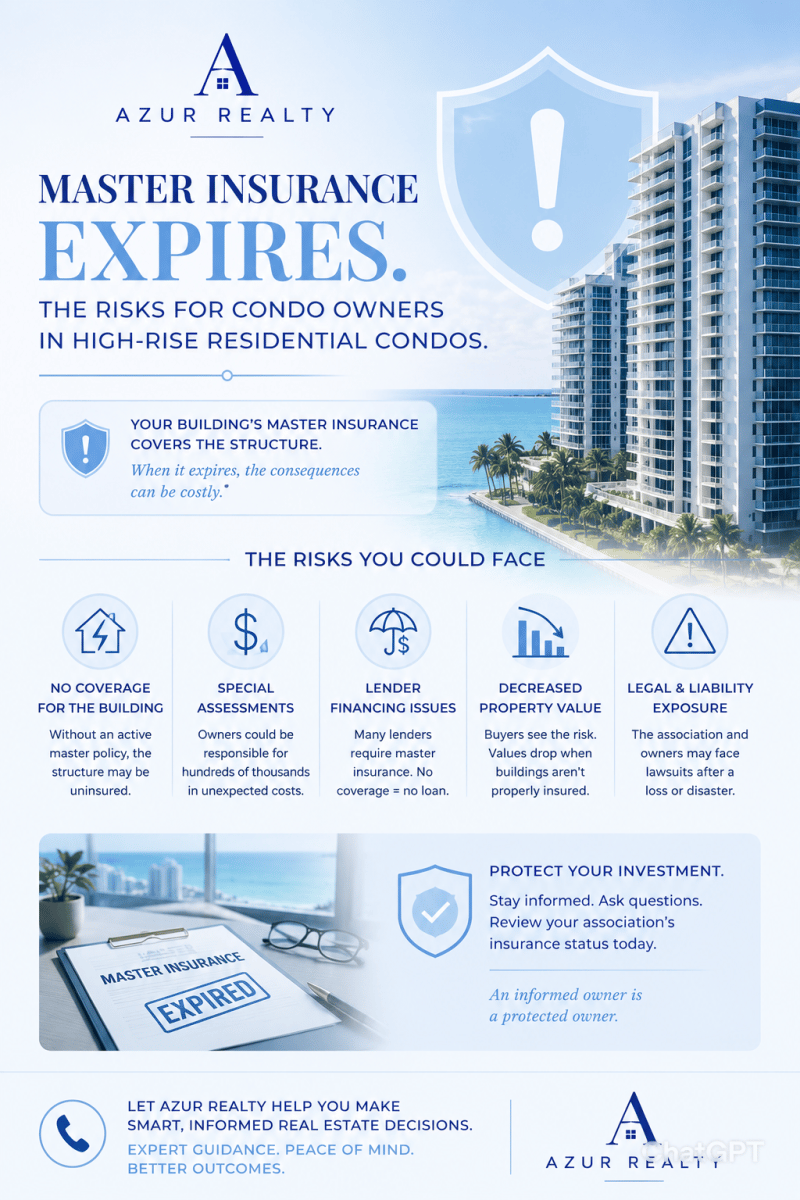
You live on the 18th floor. You pay your HOA dues every month without fail. You assume the building is covered. And then one day — through a letter slipped under your door or a notice buried in an email — you find out the master insurance policy has lapsed. Or worse, you find out after something goes wrong.
This is not a hypothetical. It is happening in South Florida high-rises right now. And the consequences for individual unit owners can be financially devastating.
What is the HOA Master Policy?
In a high-rise condo building, the HOA is required to carry a master insurance policy that covers the building structure, common areas, and, in many cases, the original fixtures inside each unit. This is what protects the lobby, the elevators, the roof, the parking garage — and often the walls, floors, and ceilings of your unit as originally built.
There are three types of master policies:
Bare walls in — covers the structure and common areas only. Everything inside your unit is your responsibility.
All-in covers the structure plus original fixtures, flooring, and built-ins inside each unit.
Single entity — covers original construction but not any improvements or upgrades made by owners after purchase.
Most owners don't know which type their building carries. That single piece of information determines how exposed you are the moment the master policy lapses.
What Happens When the Master Policy Expires?
When an HOA fails to renew its master policy — whether due to non-payment, insurer withdrawal, or an inability to find coverage in a tightening market — the entire building enters a period of serious financial and legal risk.
In Florida, if an HOA allows its master policy to lapse, lenders can force-place insurance on the building at dramatically higher cost — and pass those costs directly to unit owners through special assessments.
Here's what that means in practice:
- Your mortgage lender is notified. Most mortgage agreements require the building to maintain insurance. A lapsed master policy triggers an immediate notification to your lender — and potentially a loan default clause.
- Force-placed insurance kicks in. The lender obtains emergency coverage for the building. This coverage is expensive — sometimes 3 to 5 times the normal premium — and it protects the lender, not you.
- Special assessments hit every owner. The HOA passes the inflated insurance cost to all unit owners. Depending on the building size, this can mean thousands of dollars due with very little notice.
- Your unit may be completely unprotected. During the gap period, if fire, water damage, or a hurricane strikes — your personal belongings, renovations, and liability may have zero coverage unless your HO-6 policy is strong.
- The building becomes unsellable. No lender will approve a mortgage for a buyer purchasing in a building without active master coverage. Sales stop. Values drop. Owners who need to sell are trapped.
What You Should Do Right Now
Florida law (Chapter 718) requires condo associations to maintain adequate property insurance. But "adequate" is often disputed — and enforcement is reactive, not proactive. Don't wait for a problem to find out where you stand.
Request the master policy certificate today. Every unit owner has the right to a copy. Ask your HOA board or management company for the current certificate of insurance and confirm the expiration date.
Strengthen your HO-6 policy. Your individual condo owner's policy should cover your personal property, interior improvements, loss assessment coverage, and liability. In South Florida, also verify your flood coverage — it is rarely included by default.
Get involved with your HOA. Attend meetings. Ask about the reserve fund. An underfunded HOA is one unpaid premium away from a crisis.
If you are buying, verify before you close. Any buyer purchasing a condo in South Florida should confirm the master policy status as part of due diligence. A lapsed or soon-to-expire policy is a red flag that should affect your offer.
"In South Florida's high-rise market, the building's insurance health is just as important as the unit's square footage."
At Azur Realty, whether you're buying a condo, already own one, or are navigating an HOA insurance issue, we help our clients ask the right questions before they sign anything. Your investment deserves that level of attention.